

CASE STUDY: When one campaign lifts the whole portfolio
How Birds Eye's masterbrand campaign cast a halo over its entire product range

Marketing effectiveness is often judged too narrowly. A campaign is launched, a product is promoted, and performance is assessed against that specific objective. Success or failure is measured in isolation.
What the Simplot and Analytic Partners collaboration reveals is something more powerful. Marketing rarely works in isolation. When properly understood and measured, it can create effects that travel well beyond the original brief, lifting not just one product, but an entire portfolio.
This is where the idea of the “halo effect” moves from theory into commercial reality.

From product focus to portfolio thinking
Simplot, the owner of Birds Eye frozen foods, was facing a familiar challenge. Like many consumer packaged goods businesses, it manages a broad range of SKUs across categories that compete for attention, shelf space and investment.
Marketing decisions were often made at a product level. Budgets were allocated to support individual lines, with success defined by the immediate uplift in that product’s sales.
What was less visible, and therefore less valued, was the extent to which marketing for one SKU influenced others. As Jessica Romeo, Director for Marketing Communications, Digital and Consumer Insights APAC at Simplot Australia put it:
“We didn’t have a unified view on what was driving performance; decisions skewed towards tactics that were easy to measure rather than activities that built long-term brand strength.”
This is a common tension. Performance metrics tend to reward what is easiest to measure. Broader brand effects, particularly those that play out across categories, are harder to capture without a more sophisticated measurement approach.
Building a shared view of growth
The turning point in the Simplot engagement was not simply the introduction of marketing mix modelling. It was the way the work was approached as a partnership.
Rather than treating measurement as a reporting function, the teams worked together to build a shared understanding of how the business grows. This meant integrating data across channels, products and time horizons, and aligning stakeholders around a common set of commercial outcomes.
That collaborative approach matters. Measurement programmes deliver their full value only when they are connected to business decisions and understood across functions. Organisations that build this kind of alignment tend to unlock significantly greater growth from their analytics investments .
Revealing the halo
Once the full model was in place, a clearer picture emerged:
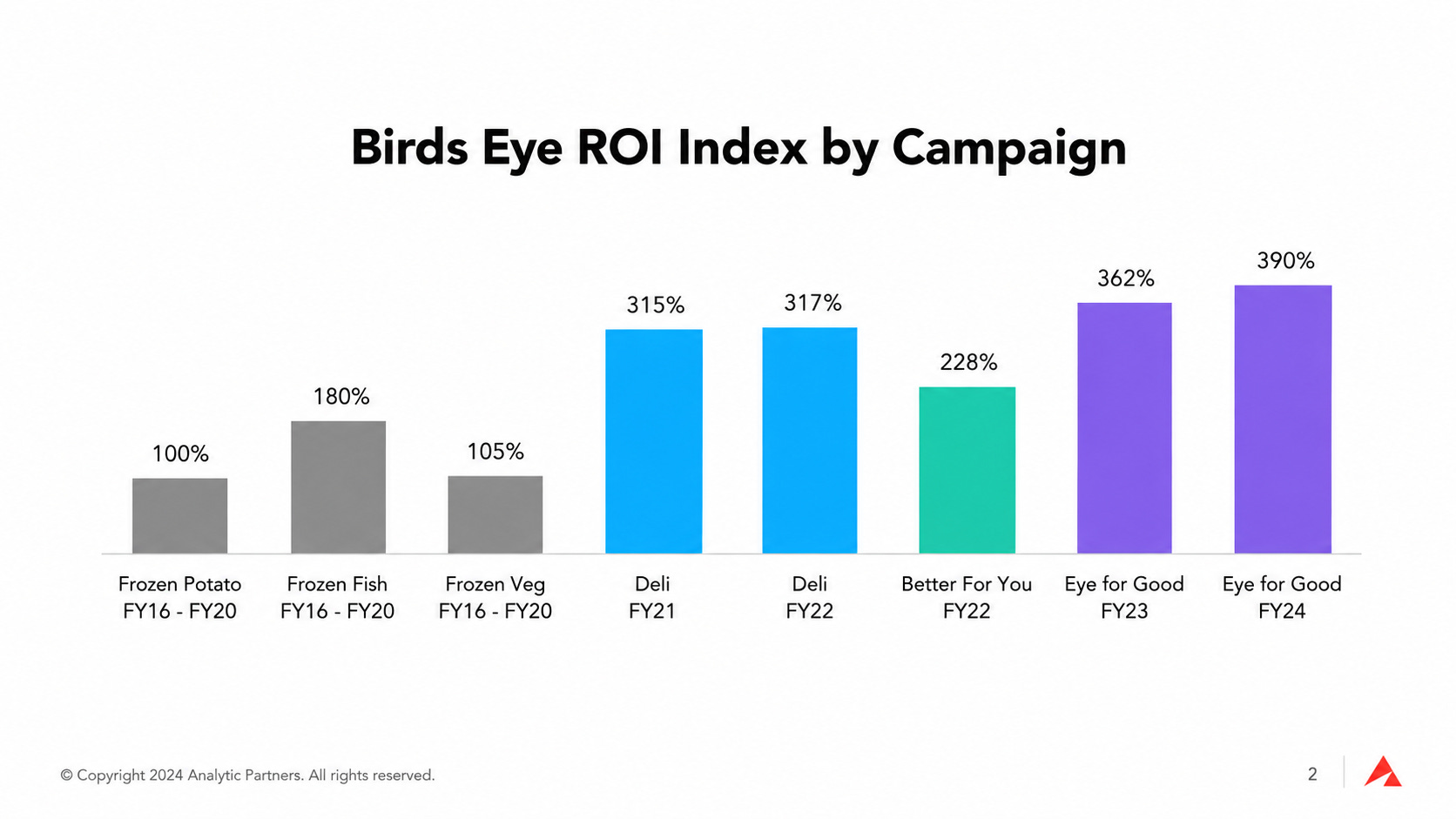
Marketing activity aimed at specific Birds Eye products was driving incremental sales beyond the targeted SKU.
Campaigns designed to promote one line were increasing demand for adjacent products, strengthening overall brand presence and influencing purchasing behaviour across the range.
In practical terms, this meant that the true return on marketing investment was being understated when viewed through a single-product lens.
The implications are significant. When halo effects are ignored, businesses risk under-investing in activities that are delivering broader value. They may also over-index on short-term tactics that appear efficient in isolation but fail to build momentum across the portfolio.
This is not a marginal effect. Advanced measurement approaches consistently show that marketing can influence outcomes beyond its immediate target, including cross-channel interactions and product halo effects.
Brand as a multiplier
What sits beneath these halo effects is the role of brand.
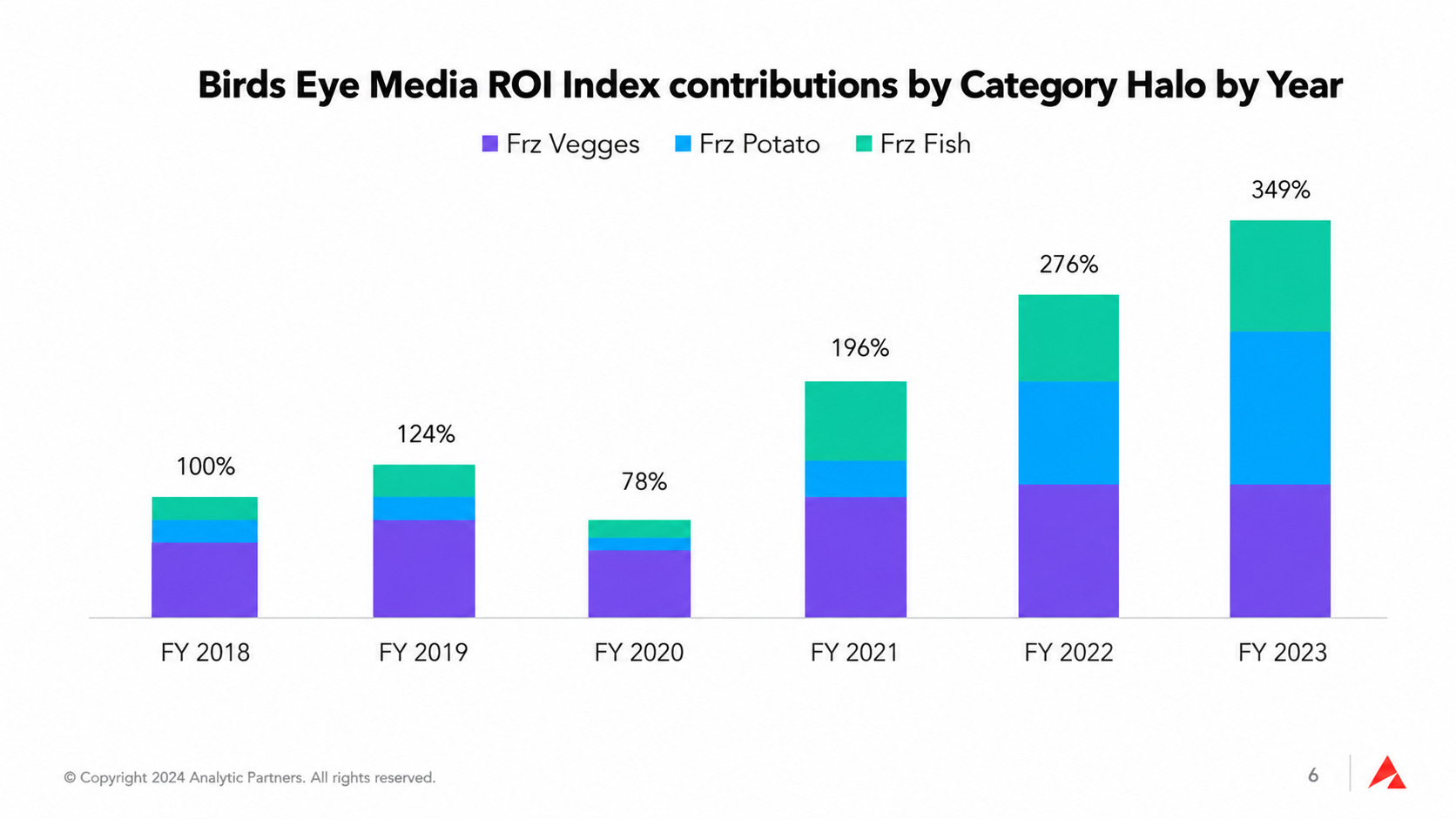
Brand activity does not operate within neat boundaries. It shapes perception, builds memory, and influences choice across categories and occasions. When a brand becomes more salient or more trusted, the benefits are felt across multiple products.
For Simplot, this became tangible, as Jessica explains:
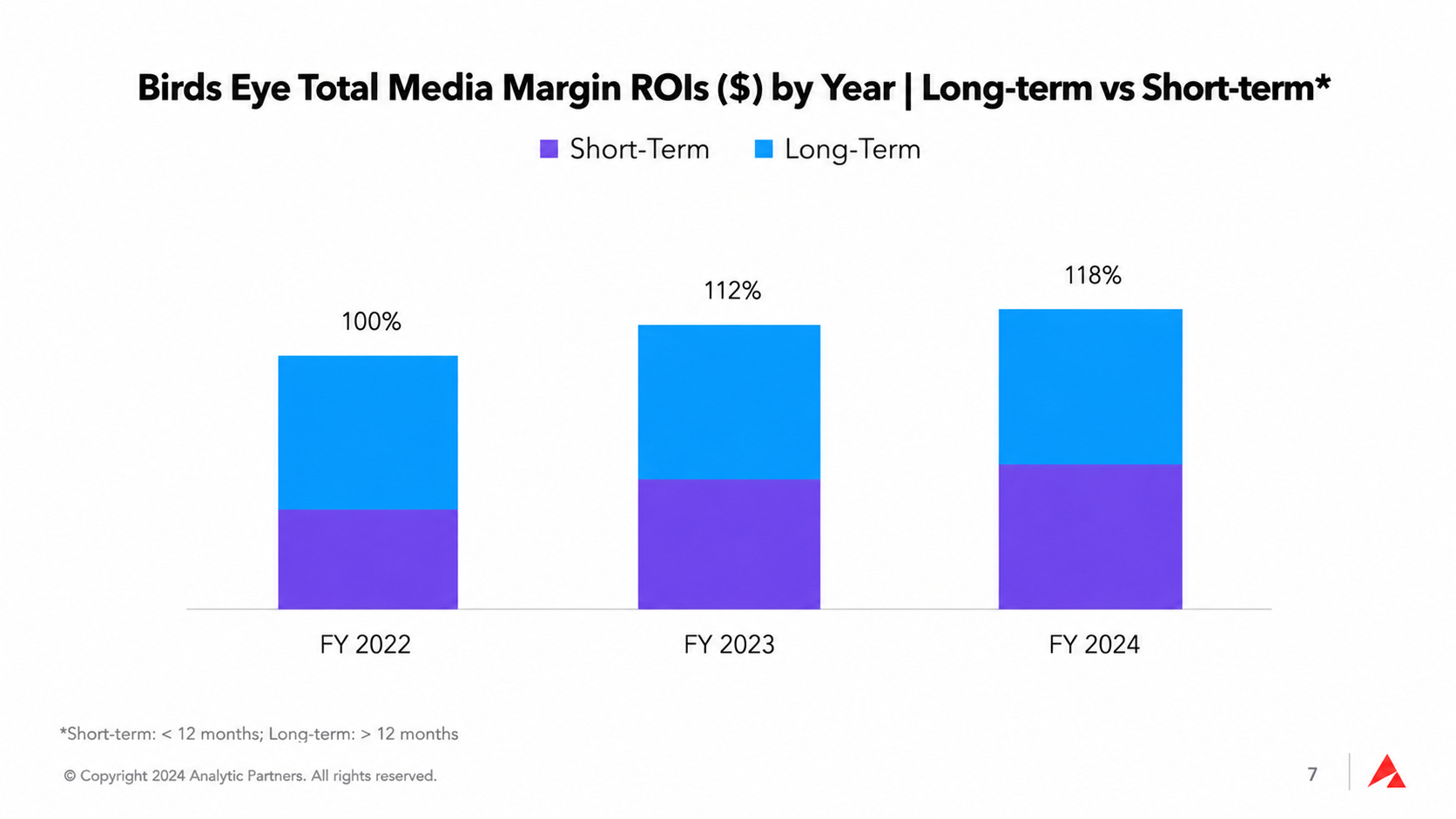
“The biggest unlock was seeing the true value of upper-funnel brand investment and how it impacted both the long and short term. It was the first time we had an evidence base that clearly showed the compounding effect of brand on efficiency, price and short-term activation. It shifted the whole senior leadership conversation.”
This is why brand should be seen as a multiplier rather than a separate line item. Strong brand equity enhances the effectiveness of performance marketing, improves conversion, and supports pricing power over time.
Evidence from broader industry research reinforces this point. Strengthening brand equity consistently improves the impact of performance activity, creating a compounding effect on commercial returns.
Rethinking optimisation
One of the most valuable outcomes of the project was a shift in how optimisation decisions were made.
Instead of focusing solely on the apparent ROI of individual campaigns, Simplot could begin to optimise for total business impact. Investment decisions were informed by a more complete understanding of how channels, creatives and products interacted.
This led to more confident budget allocation and a different way of operating. As Jessica reflects:
“Our conversations are now grounded in evidence rather than preference. We make decisions earlier, with more confidence. CMM has become part of our operating rhythm, not an annual check-in.”
It is worth noting that this kind of optimisation requires a different mindset. It moves away from the idea of marketing as a series of isolated tests and towards a more integrated view of growth.
Lessons for CMOs
There are several clear takeaways for marketing leaders.
First, measurement needs to reflect how the business actually works. Consumers do not think in terms of SKUs or channels, and neither should the measurement framework. A holistic approach that captures cross-channel and cross-product effects is essential.
Second, collaboration is not optional. The value of advanced analytics is unlocked when marketing, finance and commercial teams align around shared objectives and a common language of performance.
Third, brand investment deserves more rigorous evaluation, not less. When properly measured, its contribution becomes clearer and easier to defend.
Finally, optimisation should be grounded in total impact. Focusing on isolated metrics risks missing the bigger opportunity. The goal is not to maximise the performance of individual campaigns, but to drive sustainable growth across the business.
A broader view of effectiveness
The Simplot case is a useful reminder that marketing effectiveness is rarely linear.
A single campaign can influence multiple outcomes. A decision taken to support one product can shape demand for others. Brand and performance are not separate forces but interconnected drivers of growth. As Jessica neatly summarised:
“It’s not an either/or situation, but without brand investment, your product activity doesn’t work as hard. Brand creates the headroom for price, penetration and overall product. Product activity is critical, but it performs far better when the brand is doing its job in market.”
For CMOs, the challenge is to ensure that their measurement systems are capable of capturing that complexity. When they do, the conversation shifts. Marketing moves from being assessed on narrow metrics to being understood as a broader engine of commercial value.
And that is where the real opportunity lies.
Want to go deeper? Download the detailed case study below 👇
Congratulations on this piece! It is a brilliant and highly analytical look at the true impact of masterbrand campaigns and the often-overlooked halo effect.
I found this specific passage particularly insightful and worth highlighting:
"Performance metrics tend to reward what is easiest to measure. Broader brand effects, particularly those that play out across categories, are harder to capture without a more sophisticated measurement approach."
It is an absolute truth: the industry's obsession with short-term, easily trackable ROI often blinds businesses to the compounding, long-term value of brand building. Moving away from isolated product metrics to understand how a masterbrand lifts an entire portfolio is a crucial shift in perspective for any marketing team.
I strongly believe in the value of community. Curating a blog myself, I know firsthand how essential mutual growth and support among marketing professionals and creators are for building a solid audience and thriving on platforms like Substack.
With that in mind, would you be open to a subscription swap between our projects? I would be very happy to support your work and continue reading your insights.