

The mega sale day playbook, more media, deeper discounts, is starting to fail brands.
618 and Singles Day continue to attract enormous attention brands and consumers but the way brands succeed is changing.

China’s major ecommerce festivals remain among the most important commercial moments in the retail calendar. The two biggest, 618 and Singles Day, continue to attract enormous consumer attention and investment from brands. Yet the way brands need to approach these events is changing.
Promotional windows have become longer, media costs have continued to rise and consumers have grown accustomed to a near-constant cycle of offers, vouchers, bundles and gifts. Brands can no longer assume that more activity, more media and deeper discounts will automatically generate stronger returns.
From what we see at Analytic Partners, China’s Big Days are not becoming irrelevant but they are becoming less forgiving.

Big Days still deliver, but brands must be more selective
For many brands, Tmall and JD still achieve some of their strongest returns during Singles Day. That makes withdrawal a risky strategy. The opportunity remains significant, but the economics are becoming tougher as media inflation persists across ecommerce platforms. The answer is not necessarily to become less active but to become more selective.
Brands need to understand which investments genuinely drive incremental demand and which simply add cost. For more than half of the brands we analyse, some onsite brand media formats do not perform as strongly as media outside the ecommerce platform. That does not mean onsite activity has no value, but it does mean brands should stop treating presence as proof of effectiveness.
Every investment should have a clear role, whether that is building awareness, supporting consideration, driving conversion or acquiring new customers.
Build brand demand before the promotional window
Kelly Zheng Senior Director, Analytic Partners China says, “One of the clearest lessons from our work is that Big Day performance is often determined before the main sales event begins.”
Zheng adds, “Brand investment two to three weeks ahead of the promotional period can help companies achieve approximately 20% higher media efficiency during the event itself.”
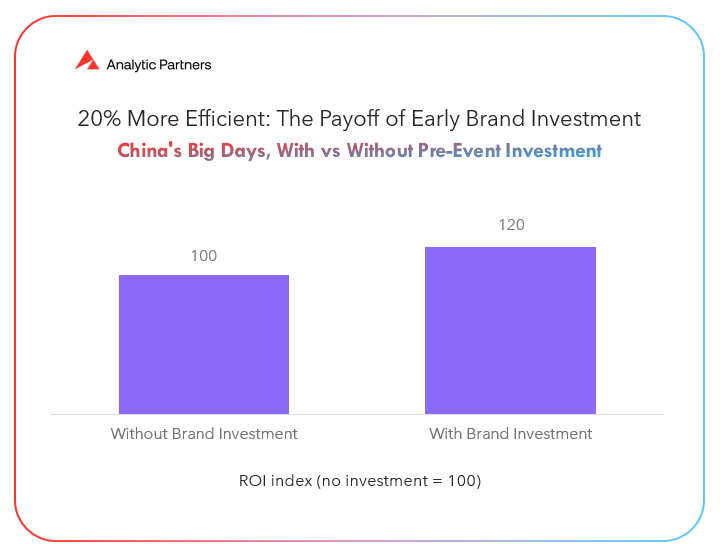
This matters because Big Days are often planned as self-contained performance campaigns. Budgets are concentrated around the sale, messaging becomes highly transactional and success is judged through immediate revenue.
Consumers, however, do not enter 618 or Singles Day with a blank slate. They bring existing awareness, preferences and purchase intent. Brands that have already built familiarity and consideration are more likely to convert when the promotional window opens.
Brand activity helps create demand. Transaction media helps capture it.
This also means brand and performance should be planned together. Separate teams and budgets may be convenient internally, but the consumer experiences a single journey.
Deeper discounts are losing some of their power
Discounting remains an important driver during China’s Big Days. “Our analysis suggests that Singles Day can be one to two times more elastic than the rest of the year, meaning consumers are more responsive to changes in price and promotional incentives,” says Zheng.
At the same time, that responsiveness appears to be weakening. We have seen discount and gift-with-purchase elasticities decline over time, suggesting that consumers may be becoming less responsive to familiar promotional mechanics.
This should concern any brand whose strategy still depends on offering a deeper discount than the previous year.
Repeated discounting can compress margins, weaken perceptions of value and train customers to wait for the next major sales event. It can also push brands into a competition based almost entirely on price.
The stronger approach is smarter promotional architecture. That could include differentiated bundles, exclusive products, tiered rewards, membership benefits or gifts with genuine perceived value. Multibuys have proved particularly popular (buy A get A, buy B get C, etc). The goal is to give consumers a compelling reason to buy while protecting more of the brand’s economics.
Concentrate transaction media at the moments that matter
As promotional windows have expanded, many brands have spread their investment across a longer period, which can dilute returns.
Zheng reiterates, “Our analysis indicates that the early Big Day phase, particularly the first week, captures much of the conversion opportunity. Brands with more effective flighting can achieve up to twice the monetisation capability of those that distribute investment less efficiently. The lesson is that winning does not always require more spend but better timing.”
Brands should use historical evidence to identify when consumer responsiveness is highest, then concentrate transaction media around those moments. A campaign may appear successful in aggregate while still concealing periods of overspending, weak incremental returns or missed demand.
Measure customers as well as transactions
Big Days also remain powerful customer-acquisition events.
The proportion of new customers acquired during these periods can be similar to their share of revenue. That suggests 618 and Singles Day are doing more than concentrating purchases among existing buyers. They are also bringing significant numbers of new customers into the brand and those customers can create value long after the event ends.
The first transaction should therefore be treated as the beginning of the commercial equation. Brands also need to understand whether new customers return, whether they later buy at full price, whether they enter other categories and how much it costs to retain them.
This is why conversion-focused investment should remain balanced with upper-funnel demand creation. A brand that concentrates only on shoppers already close to purchase may generate a strong sales result while failing to replenish future demand.
Take a broader commercial view
Platform reporting can tell brands what sold, where consumers clicked and how many conversions were recorded. It is less able to explain how offsite media created demand, how discount depth affected profitability or whether newly acquired customers created lasting value. These questions require a broader commercial view.
At Analytic Partners, we look at media alongside price, promotion, customer acquisition and other business drivers. That makes it possible to understand what genuinely produced the result and how the next event should be planned.
China’s Big Days still offer exceptional commercial potential but the era of relying on scale, visibility and aggressive discounting is fading.
The brands most likely to succeed will build demand early, protect the value of their offer, concentrate investment around the strongest moments and measure customers as carefully as they measure transactions.
In a more expensive and less responsive environment, winning will depend less on how loudly a brand participates and more on how intelligently it plans.
Planning for the next 618 or Singles Day? Speak to the Analytic Partners China team to understand how media, pricing, promotions and customer acquisition are working together, and where your next growth opportunities may lie.