


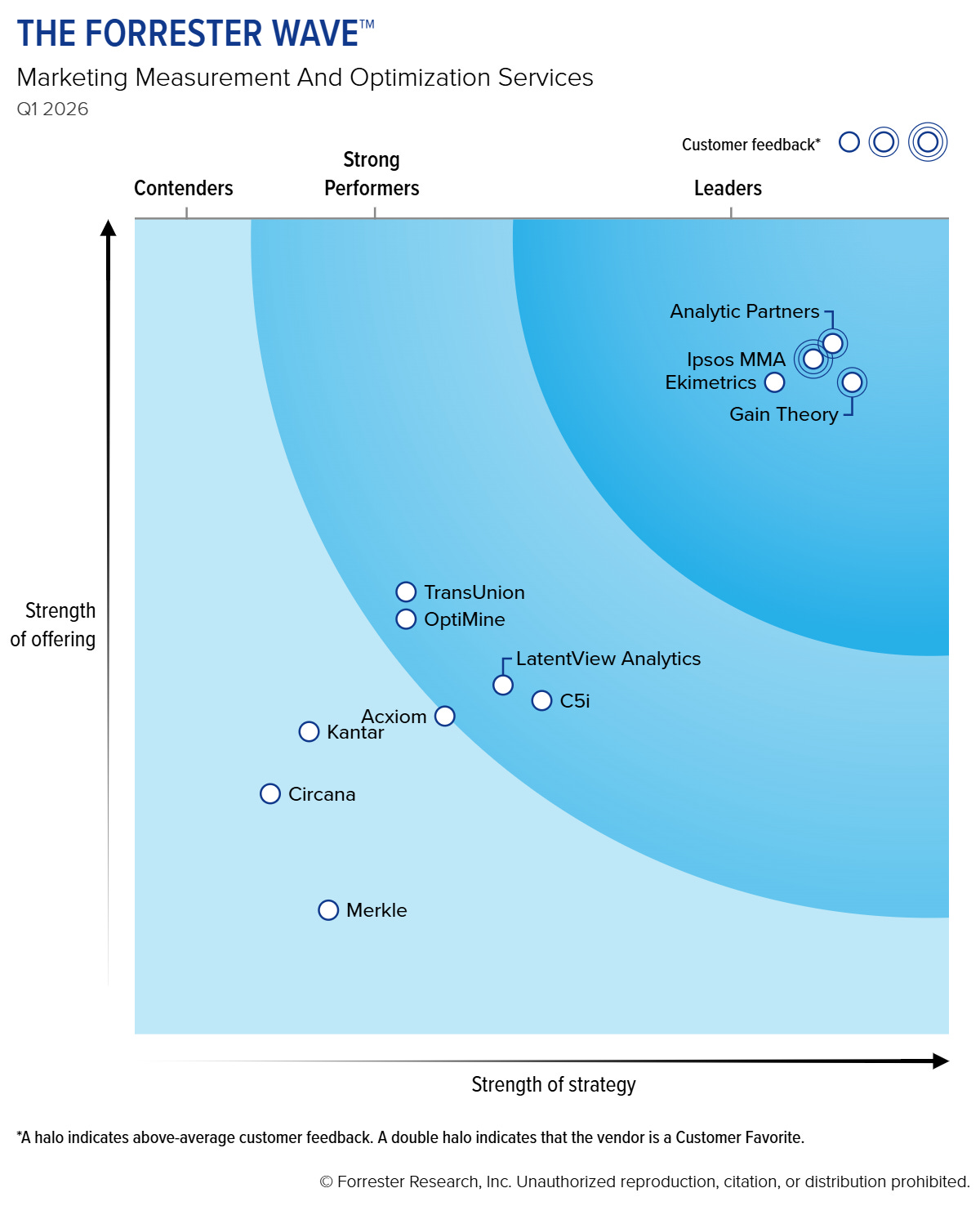
Of course we are delighted to have once again been named a Leader in The Forrester Wave™: Marketing Measurement and Optimisation Services, Q1 2026 but this is not a “humbled and proud” post because, for the CMOs I talk to in APAC, awards are not their priority. Growth is. Margin is. Credibility with their CFO is. And clarity in a world drowning in dashboards is.
So the real question is not what this says about us. It is what it signals about where marketing measurement is heading.
Marketing measurement is no longer about reporting performance. It is about shaping commercial decisions.

The measurement reset
We are in the middle of a reset.
For the past decade, marketing measurement has skewed heavily towards what is fast and visible. Performance metrics. Click-through rates. Cost per acquisition. Attribution models that generously reward the last touchpoint.
But something has shifted.
CMOs are seeing performance plateaus. Media costs are rising. Privacy changes have eroded signal. And short-term optimisation is no longer delivering sustainable growth.
At the same time, finance teams are asking sharper questions. Not about impressions, but about enterprise value. Not about channel efficiency, but about incremental growth.
The Forrester Wave recognition reflects this inflection point . It signals that the market is rewarding partners who go beyond channel reporting and connect marketing to total business performance.
From Marketing Mix Modelling to commercial intelligence
Marketing Mix Modelling remains the backbone of serious measurement. In APAC especially, where many organisations are still strengthening their causal foundations, MMM is not legacy. It is mission-critical.
Done properly, it provides what no dashboard or attribution model can: a rigorous, econometric view of what is truly driving growth. It quantifies incrementality. It clarifies the balance between brand and performance. It gives marketing credibility in the boardroom.
That alone makes it indispensable.
But for leading organisations, MMM is also the starting point, not the finish line.
The brands outperforming in volatile markets are those that build on MMM to:
Connect marketing impact to total commercial performance
Integrate controllable and non-controllable drivers such as pricing and distribution
Align marketing and finance on shared definitions of ROI and value
Use forward-looking simulations, not just retrospective diagnostics
Protect brand investment while optimising short-term returns
In other words, they treat MMM not as a periodic study, but as the engine inside a broader commercial intelligence capability.
MMM tells you what drove growth.
Commercial Intelligence ensures you act on it, consistently and at scale.
That progression from marketing analytics to enterprise decisioning is central to why leadership in this category matters.
AI can accelerate insight. But it cannot compensate for weak fundamentals.
The AI reality check
There is no escaping the AI conversation. Nor should we.
AI and machine learning are powerful tools. But they are amplifiers, not foundations. If the data is fragmented, if KPIs are misaligned, if brand impact is ignored, AI will simply optimise the wrong things faster.
Forrester’s evaluation makes clear that governance, rigour and scalability matter as much as innovation .
In APAC’s fast-moving markets, that discipline is not optional. It is protective.
The brand multiplier effect
One of the most consistent findings from our ROI Genome research is that brand is not a “nice to have”. It is a multiplier.
Brands that rebalance from a performance-only strategy to a mixed brand and performance approach see dramatic improvements in revenue ROI. Conversely, those that over-index on performance alone risk eroding returns over time.
This is not theory. It shows up in the numbers.
Performance tactics convert demand. Brand investment creates it. The most effective organisations operate at both paces simultaneously.
And this is particularly relevant in APAC, where growth expectations are high but competition is fierce. Short-termism is seductive. But sustainable advantage is built over time.
The brands that win are not the fastest at chasing the next metric. They are the most disciplined at building systems that compound.
Beyond marketing
There is another uncomfortable truth measurement must address.
Marketing typically drives between 10% and 50% of business performance, depending on category and context. The rest comes from pricing, distribution, operations, macroeconomic factors and competitive dynamics.
If measurement ignores these drivers, marketing becomes an easy scapegoat when performance dips.
If measurement incorporates them, marketing becomes a strategic partner in enterprise decisioning.
That broader commercial lens is increasingly what defines leadership in measurement.
What this means for CMOs
Rather than asking who sits in the Leader quadrant, the more useful questions are:
Does our measurement framework reflect the full commercial picture?
Are we balancing brand and performance effectively?
Is finance aligned on definitions of ROI and success?
Are we simulating future scenarios, or simply explaining the past?
Do we trust our measurement enough to defend investment when budgets tighten?
Recognition in The Forrester Wave™ 2026 is encouraging, but its real value lies in what it represents: a shift towards disciplined, integrated, commercially grounded marketing measurement.
Because ultimately, leadership in measurement is not about models. It is about giving CMOs the confidence to lead.
If you would like to explore how to strengthen your MMM foundation while evolving towards a fully integrated Commercial Intelligence capability, our team across the region would be happy to connect.

Such an important and timely perspective. 👏
One of the biggest risks in today’s AI-accelerated environment is that we amplify noise instead of insight. If the underlying commercial model isn’t clearly defined — and if data fidelity, lineage, and cross-functional drivers aren’t structurally embedded — AI simply scales confusion faster.
In my experience leading analytics across marketing and FP&A, the real unlock happens when measurement frameworks integrate pricing, operational capacity, channel mix, and macro signals — not just media metrics. That’s when marketing stops being evaluated in isolation and starts informing enterprise decision-making.
Durable data infrastructure, governed definitions, and transparent lineage aren’t “back-end hygiene” — they’re strategic assets. Without them, attribution becomes fragile. With them, marketing becomes a growth architect.
Super insightful article — this broader commercial lens is exactly what modern measurement leadership requires.
Short-term optimization is a known trap. But CMOs rely on performance metrics because they provide the 'Data-Driven Executive' mask to hide behind when real strategic risks fail. It's safe to blame a CPM. What bold move are you avoiding by hiding behind the dashboard?