

LIVE FROM CAMPAIGN 360: When the world changes, your marketing plan HAS to change with it.
The marketers who can adapt will have the upper hand.

Day one of Campaign360, Singapore’s biggest marketing industry event, has just ended and I have retired to the promenade at Marina Bay Sands with a glass of bubbly to reflect on a deeply stimulating day of presentations and conversations.
As the light fades across the bay, I keep coming back to the event’s theme: Human Connection & Intelligent Marketing. It feels exactly right for the moment we are in, and for the conversations I had throughout the day with marketers, media leaders, agencies, technologists and fellow measurement obsessives.
Across the stages, booths and corridor conversations, the same questions kept surfacing. How do we use AI without losing human creativity? How do we build brands when attention is fragmented? How do we prove marketing’s value when business conditions keep shifting? How do we make better decisions when the data we have only tells part of the story?
For us at Analytic Partners, these questions are very real. They are the questions we help marketers answer every day.
That’s why, on our booth, we invited delegates to sit down with real-life modellers to ask their burning questions about data, dashboards and Marketing Mix Modelling. Mikael Dannerstedt, AVP Asia; Zhesen Tong, Director Asia and Evelyn Liao, Senior Marketing Science Analyst, spent the day speaking with marketers who want to understand what their dashboards might be missing, how MMM really works and how to make better budget decisions in a volatile market.
It is a simple idea, but a useful one. Put a marketer in front of a modeller and the conversation very quickly becomes practical.
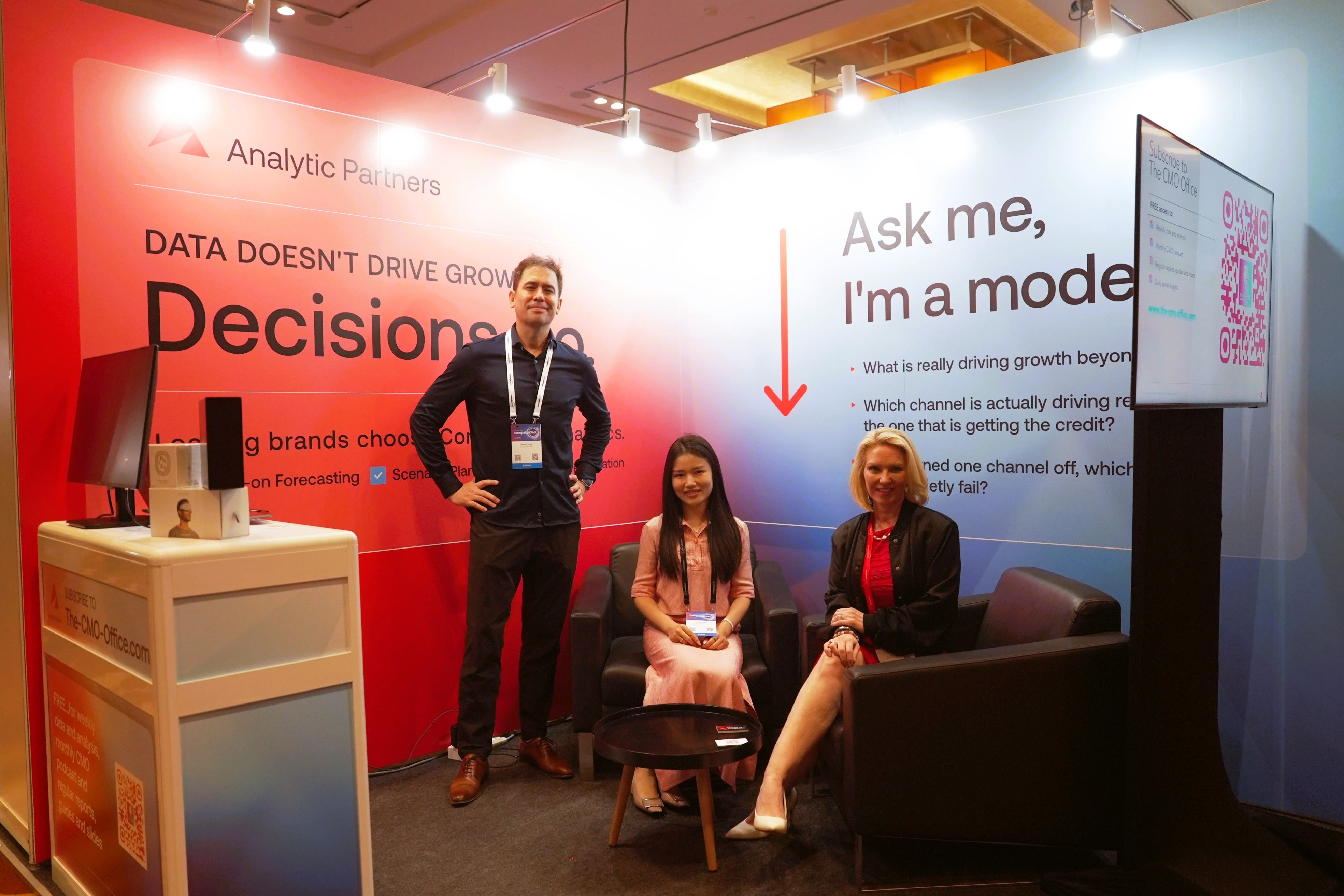
Unsurprisingly, people want to know how to measure the impact of brand. How to understand what is really driving sales. How to avoid over-crediting lower-funnel channels. How to explain marketing’s contribution to finance. How to respond when a plan that makes sense six months ago suddenly feels out of date.
They also wanted to win our CMO Survival Kit, containing a Diptyque candle, Ostrich sleep mask, Bacha coffee sachets, TWG herbal teas, de-stressing pillow spray and our exclusive “I’ve Got No Budget” enamel pins, designed to protect marketers from predatory vendors at events. (That last part is, mostly, a joke.) To do so they had to subscribe to The CMO Office and I am delighted to announce today’s winner is:
Nishant Udeshi
Director, Portfolio and Brand Marketing
Marriott International.
Congratulations Nishant, may your coffee be luxurious, your sleep mask effective and your budget pin a powerful shield against overly enthusiastic sales pitches.
We signed up 20 new subscribers today, which is a lovely result. It also reminds me that marketers are still hungry for practical, useful, commercially grounded insight. Less noise. Less jargon. Fewer dashboards for the sake of dashboards. More insight they can actually use.
When the plan stops reflecting reality
That question of how to respond when a plan made six months ago suddenly feels out of date was also at the heart of my keynote on the learning stage: Your Marketing Isn’t Built for What’s Coming.
My message was a direct one. Many 2026 marketing plans are already obsolete.
That may sound rather blunt, but look at the world marketers are planning for. Conflict is affecting trade, fuel costs and consumer sentiment. Inflation continues to influence household decisions. Supply chains remain fragile. AI is reshaping expectations. Platforms are fragmenting. Consumers across Southeast Asia are behaving in increasingly different ways depending on market, income, category and context. Yet many marketing plans are still built around assumptions made months ago, sometimes nearly a year ago!
The danger lies in the invisibility of those assumptions. A plan can still look beautifully organised in a spreadsheet. A dashboard can still show clicks, conversions and engagement. A campaign can still appear to be performing. Meanwhile, the commercial reality around it may have changed completely, which is where marketers need to broaden their view.
Marketing does not operate in a vacuum. It is affected by pricing, distribution, availability, competitor behaviour, category demand, macroeconomic pressure, media inflation and shifts in consumer confidence. Measurement that fails to account for those forces risks giving marketers confidence in an incomplete picture.
Why marketers need a wider lens
Our ROI Genome global campaign database shows why this matters. Marketing is directly responsible for 5% - 20% of key business outcomes in APAC such as sales or new customer acquisitions, which means a large share of growth comes from factors outside marketing, including availability, consumer trends and macroeconomic forces. That does not diminish marketing’s role but it demonstrates precisely why we need to measure it properly.
When marketers want a stronger voice in the boardroom, we need to show how marketing interacts with the whole business. We need to understand where marketing is driving growth, where external factors are helping or hurting performance, and where different choices could produce better outcomes.
That is where Marketing Mix Modelling becomes so valuable. Used well, MMM helps marketers move beyond post-campaign reporting and towards forward-looking decisioning. It can show what is really driving performance, how channels work together, where diminishing returns are appearing and how a plan should change when the market changes.
Southeast Asia does not move as one
This feels especially relevant after reading commentary from Rica Facundo, Managing Editor at WARC APAC, on findings from the Mastercard Economics Institute presented at Omnicom Media Asia Pacific’s recent OM Forward event.
The findings underline something every regional marketer should be paying attention to: economic pressure produces divergence.
In the Philippines, affluent consumers are reportedly increasing discretionary spend while mass-market consumers pull back. In Singapore, cafés are at 161% of 2019 sales levels, outperforming restaurants, fast food and food courts. Luxury spending across Southeast Asia is shifting location, with Singaporeans buying overseas, Filipinos shopping at home and Thais buying online. Travel demand continues, with routes moving through China and Northeast Asia as these markets gain importance as transit hubs."
That is the reality of marketing in Southeast Asia. The region does not move as one. Consumers do not respond to pressure in the same way. Categories behave differently. Channels play different roles in each market. A regional average can easily hide the most important parts of the story.
The marketers who adapt will have the advantage
☝️That, ultimately, is my biggest takeaway from Campaign360.
Marketing plans cannot be built once a year and left untouched while the world changes around them. The pace of change across Southeast Asia makes that too risky. The marketers who perform best in 2026 will be those who keep updating their view of the market, connect their measurement to business outcomes and make sharper decisions as conditions evolve.
The future will reward the marketers who know when the plan has stopped being true and we can be your source of truth.