


If Part 1 of this double-header reframed search as a reflection of upstream demand rather than the starting point, the next question is unavoidable: what happens to attribution when that reflection becomes narrower, cleaner, and harder to inflate?
This is where most of the anxiety around AI search actually sits. Not in disappearing clicks, but in the systems marketers have relied on to explain performance.
AI is not breaking search first. It is breaking the shortcuts we have relied on to explain it.

The assumption search has always benefited from…
For years, search has occupied a privileged position in the marketing mix. Not because it always created the most value, but because it was the easiest place to see outcomes.
Search sits close to conversion. Attribution models reward proximity. Dashboards fill up with clicks, cost-per-acquisition and conversion rates. Budgets follow what looks provable.
Over time, this created a comfortable assumption: if search numbers were strong, marketing must be working. Low-intent and high-intent queries were bundled together. Generic exploration and brand-led intent were credited equally. Volume became a proxy for effectiveness.
That assumption only held because search absorbed a large amount of low-intent discovery. AI is now removing that layer.
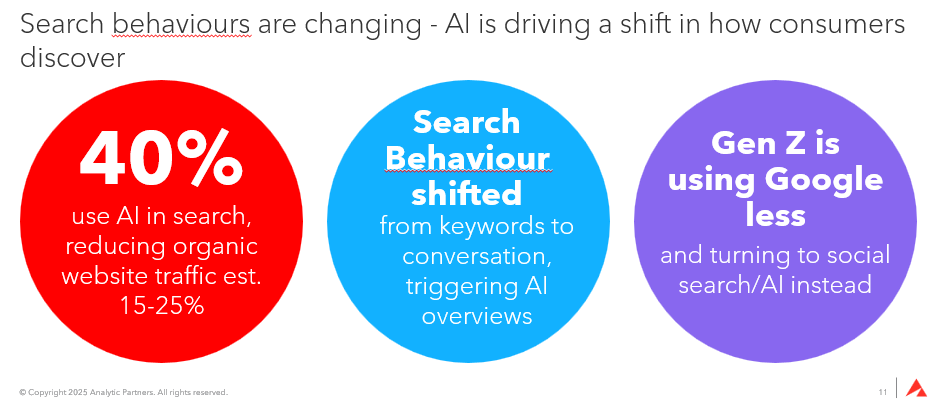
AI didn’t create the attribution problem. It removed the padding.
AI-driven search experiences disproportionately filter out low-intent behaviour. Informational queries are answered directly. Exploratory research happens earlier, elsewhere. Fewer users need to click through to move forward.
What remains is a smaller, more concentrated set of higher-intent searches.
From a reporting perspective, this is destabilising. Clicks decline. Volumes soften. The numbers that once propped up performance narratives are no longer there.
What AI removes is not value, but the comfort of easy explanations. AI didn’t invent this flaw. It exposed it.
What this looks like inside real marketing teams
This shift is not theoretical. It shows up in the day-to-day reality of managing search as Debra Soon, CMO at Singlife, explains:
“Google search is not dead yet, but it is definitely diminishing. We have to continually fight, adjust and tweak our search strategies daily to stay on top, using different tools and partners. For instance, we have already deployed Generative Engine Optimisation. We can’t just pay an agency and leave it – just like anything else in the media, marketing and consumer experience today. Stay on trend!”
What matters here is not the word “diminishing”, it’s the effort. Search is being worked harder because it is being asked to stand in for something bigger: a coherent explanation of growth. As AI removes low-intent volume, that burden becomes harder to carry.
AI doesn’t shorten journeys. It makes them harder to attribute.
One of the more misleading narratives in the AI conversation is that customer journeys are becoming shorter or more compressed. In reality, they are becoming more fragmented and more category-dependent.
AI is now used early as a discovery and research tool, mid-journey to validate options, and late alongside search to support final decisions. Some categories involve weeks of consideration and multiple returns to search. Others move from query to checkout in minutes.
The length of the journey hasn’t changed but the distribution of influence across it has. Unfortunately, attribution systems still look for a single moment to credit whereas AI spreads influence across many such moments.
Why attribution breaks in an AI-shaped journey
Attribution still has value, but mainly within individual channels. It is useful for optimising bids, creative and targeting inside search or paid social.
What it cannot do is explain how channels work together, how brand activity increases the effectiveness of search, or how upstream discovery changes downstream efficiency. Platforms are simply not built to capture those interactions.
As AI removes low-intent noise and search volumes fall, those limitations become much harder to ignore.
Why search looks weaker in an AI world
When low-intent discovery disappears, search stops functioning as a convenient justification for growth. What shows up in search increasingly reflects the strength of upstream marketing activity, not the independent power of the channel itself.
This is why search appears to weaken in an AI-shaped environment. Not because it has stopped working, but because it has stopped carrying volume it never truly owned.
Search is no longer inflating the story. It is revealing it.
Why Marketing Mix Modelling matters here
This is where Marketing Mix Modelling earns its relevance.MMM shows how brand, media and discovery activity increase the value of search, rather than crediting search for demand it did not create. It allows marketers to separate demand creation from demand capture at a moment when that distinction has become commercially important.
The risk is not that search delivers less value. The risk is continuing to read search performance as a standalone growth story when the system around it has changed.
Search has always been strongest when it reflects effective marketing elsewhere. AI is simply forcing that truth into the open.
Need help understanding which search clicks actually drive growth? Meet our modellers and see how Marketing Mix Modelling reveals the true value of search within a fully integrated marketing strategy.
This is such a great post Nikki !