

Stronger Together: Why Channel Synergy Is Marketing’s Real Advantage🤝
It's not about the 'best' channel but how channels work best together.

For years, marketing has been framed as a choice. Brand or performance? Digital or offline? Awareness or conversion? In reality, that is not how growth works, especially in markets like Singapore, Australia and Malaysia where consumers are sophisticated, media‑savvy and constantly switching between channels.
The real advantage does not come from picking the ‘best’ channel. It comes from how channels work best together. That is channel synergy, and it is one of the most powerful, and most misunderstood, levers available to modern CMOs.

What we really mean by channel synergy
Channel synergy is not about presence everywhere for the sake of it. Nor is it about simply adding more channels to a media plan. True synergy happens when activity in one channel amplifies the impact of another, lifting total effectiveness beyond what each channel could deliver on its own.
In practical terms, synergy shows up when:
Brand activity makes performance channels convert more efficiently
Upper‑funnel channels extend the impact window of lower‑funnel activity
Offline media triggers search, social and ecommerce behaviours
Consistent creative ideas reinforce memory across multiple touchpoints
When this happens, the whole becomes greater than the sum of its parts.
Why synergy matters more in APAC markets
While the principles of synergy are universal, they are particularly important in Singapore, Australia and Malaysia.
1. Consumers are highly connected and highly sceptical
Singapore and Australia consistently rank among the most digitally mature markets in the world. Malaysia is not far behind, with rapid growth in ecommerce, social commerce and video‑led platforms. Consumers move fluidly between channels, often within minutes, and they are adept at filtering out noise.
A single‑channel approach simply does not map to how people actually make decisions. Synergy does, because it reflects the messy, non‑linear reality of modern buying behaviour.
2. Performance channels are under pressure
Across all three markets, CMOs are feeling the squeeze of rising costs, signal loss and diminishing returns in lower‑funnel channels. Search and paid social remain critical, but they are increasingly efficient only when supported by brand‑building activity elsewhere.
This is where synergy earns its keep. Stronger brand presence improves response rates, lowers acquisition costs and extends the shelf life of performance activity.
3. Media fragmentation is the norm
From BVOD and connected TV in Australia, to out‑of‑home and transit media in Singapore, to social‑first video and marketplaces in Malaysia, attention is spread thin. Synergy is what reconnects these fragments into a coherent growth engine, so each exposure reinforces the next.
💡💡Across thousands of campaigns, analysis by our ROI Genome database demonstrates that a combined offline + online approach can be around 50% more efficient than offline alone, and often more effective than online-only strategies.
The compounding effect of brand and performance
One of the biggest myths in marketing is that brand and performance operate on different timelines. In reality, they operate on the same timeline, just with different decay curves.
A recent APAC-focused report from our partners WARC, The Pace Principle, frames this as operating at two speeds at once. A sprint pace, driven by performance activity that secures short-term wins, and a long-distance pace, driven by brand-building that sustains growth over time.
The mistake is treating these as alternatives, rather than complementary modes that must be managed together because brand activity does not only work ‘in the long term’. It also boosts short‑term response by:
⬆️ Increasing mental availability at the point of choice
⬆️ Improving the effectiveness of calls‑to‑action
⬇️ Reducing reliance on discounts and promotions
Equally, performance activity does not exist in isolation. Without brand support, it tends to hit a ceiling faster and decay more quickly.
Synergy is what unlocks the multiplier effect between the two.
💡ROI Genome indicates that companies with a healthier balance between brand and performance investment can see ROIs up to 90% higher than those that over-index on performance alone.
Where synergy shows up in real campaigns
While the specific channel mix will differ by market and category, successful synergistic programmes often share common patterns:
1. Offline that fuels online
In Singapore and Australia, TV, BVOD and out‑of‑home consistently act as powerful triggers for search and digital engagement. The strongest results are seen when these channels are planned together, not measured in silos.
2. Video as the connective tissue
Video, whether delivered through broadcast, streaming or social platforms, often plays a central role in synergy. It builds memory, emotion and scale, while feeding more efficient downstream performance.
3. Creative consistency across touchpoints
Synergy is not just about media. It is about ideas. When the same distinctive assets and messages show up across channels, each exposure works harder. This is especially important in fast‑scroll, mobile‑first environments like Malaysia and Singapore.
Measuring synergy without falling into the attribution trap
One of the reasons synergy is under‑invested in is measurement. Last‑touch and platform‑centric attribution models systematically undervalue channels that do not sit closest to conversion.
To understand synergy properly, CMOs need to:
👀 Look beyond immediate clicks and conversions
📏 Measure combined channel effects, not just individual ROI
💹 Account for delayed and indirect impact
⚗️Use methods that can see across online and offline
But too often, we stop at measuring 1–2 channels in isolation — typically paid search and social — while ignoring the full ecosystem.
We don’t often evaluate how different combinations behave at different stages of the campaign. For example, a product launch might demand TV + digital (+ OOH, if budgets allow) to front-load awareness. But what if you can’t sustain TV over time? Can OOH and digital take over the load? And what ratio of spend makes sense as commercial goals evolve? These are the kinds of planning decisions synergy thinking makes possible — but only if you’re set up to see them.
And that requires measurement systems that reflect how advertising actually works — across time, across touchpoints, and across combinations.
💡ROI Genome studies show that campaigns planned with coordinated channel roles — rather than channel-by-channel — can drive up to 35% higher ROI.
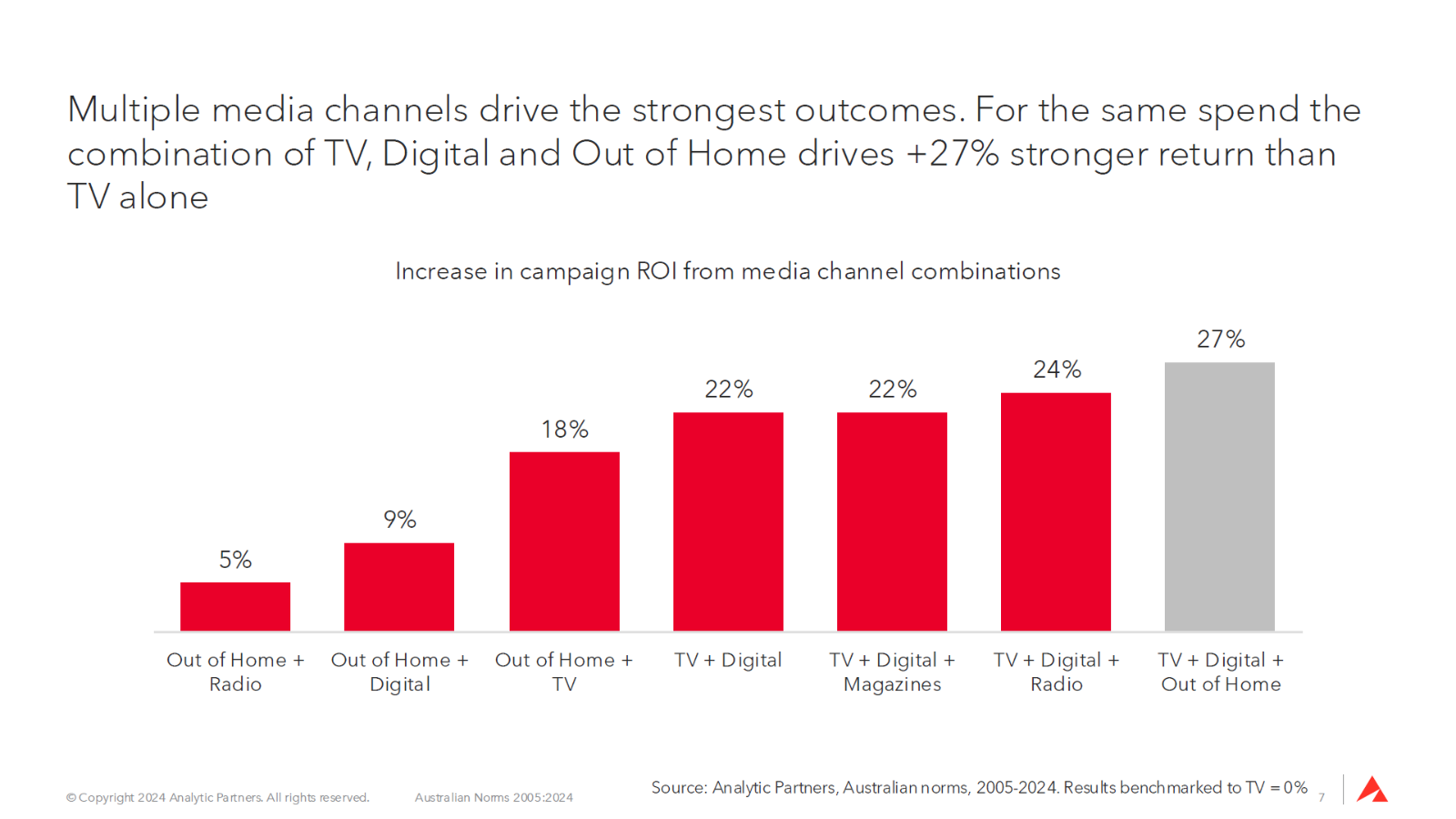
This is less about finding the perfect model and more about adopting a holistic measurement mindset.
What CMOs in APAC should do next
If you are operating in Singapore, Australia or Malaysia, and growth feels harder than it should, the answer is unlikely to be ‘optimise harder’ in one channel. It is more likely to be ‘connect the dots’ across channels.
Three practical steps:
Plan channels together, not sequentially
Invest in ideas that travel well across media
Measure success at the system level, not the channel level
Channel synergy is not a nice‑to‑have. In today’s fragmented, performance‑obsessed landscape, it is one of the few remaining sources of sustainable advantage.
And for CMOs willing to embrace it, it tends to reward them twice: with better short‑term results AND stronger long‑term growth.
Need help joining your channels up or cutting them down? Why not talk to one of our modellers about how they can find efficiencies and increase effectiveness so you budget goes further and works harder?