

The 18-Week Amnesia Effect: Why Your Most Defensible Budget Cut Can Be Your Most Expensive
Every marketer knows the feeling. The forecast wobbles, finance wants options by Friday, and the fastest way to look disciplined is to go dark for a quarter and wait it out.

It feels responsible. But it rests on a misunderstanding of what happens when a brand goes quiet.

As Analytic Partners’ Managing Director for Australia and Asia, Paul Sinkinson, puts it, “A pause isn’t a pause. To the market, it’s forgetting.”
Marketing investment does not behave like many of the other costs on a balance sheet. You cannot simply switch it off, preserve value and expect to return to where you left off a few months later. Markets have memory, and that memory has a direct bearing on the commercial performance marketers are ultimately asked to defend.
Going dark is not a pause
Here is what we see across the data at Analytic Partners. ROI Genome research shows it takes 15 to 20 weeks of sustained advertising for a campaign to reach maximum impact. The build is slow because memory is slow.
As Sinkinson notes, “Switching off doesn’t return you to where you paused. It sends you backwards.”
The numbers are unforgiving. Our modelling shows that a brand going completely dark can take around twice as long to recover as it took to lose momentum. More importantly, the road back is expensive. Getting back to where you started can require more than twice the marketing investment you saved by switching off in the first place. Go dark in June and you may not return to full strength until December. What looked like a prudent quarterly saving can quickly become six months of underperformance and a repair bill that far outweighs the original budget cut.
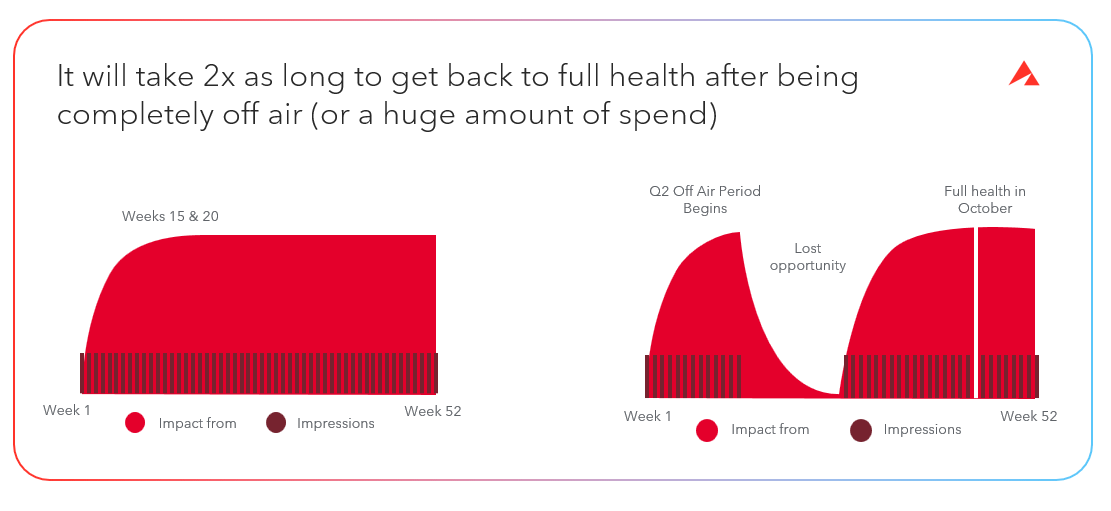
Worse, the damage is invisible when the decision is made and obvious only later. The hit to demand and brand recall surfaces months down the line, often at the exact point a marketer is trying to isolate the drivers of growth, defend marketing investment or prove an effectiveness outcome.
Few marketers would argue that going completely dark is the answer. The instinct quickly shifts to something that feels more measured. Don’t switch everything off. Just trim the channel pulling its weight the least.
This is where good marketers get fooled.
So which channel do you trim?
The trouble starts with the number on the dashboard. Most reporting ranks channels by average ROI, and average ROI is the wrong number for a budget decision. It tells us how an investment performed in hindsight, not what happens next.
Sinkinson argues that this is one of the biggest traps marketers fall into. “Average ROI tells you how an investment performed in hindsight, not what the next dollar will do or what the dollar you remove is holding up.”
That distinction matters because marketers are not paid to explain yesterday’s decisions. They are paid to make tomorrow’s.
Search and display are where this catches people out. Both saturate fast. The highest-intent buyers convert first, every extra dollar reaches a less valuable audience, and the average return begins to soften. A dashboard can make that look like a channel has stopped working.
It has not.
A channel can be well into diminishing returns and still be one of the largest contributors to the business. Cut it because the dashboard called it inefficient, and total return falls.
Then there is the part a channel-by-channel view cannot see. Channels are not independent. They prime and amplify one another, creating value that often shows up somewhere else.
Analytic Partners’ ROI Genome shows that campaigns planned with coordinated channel roles, rather than channel by channel, can drive up to 35% higher ROI. A healthier balance between brand and performance investment can deliver returns up to 90% higher than over-indexing on performance activity alone.
The uncomfortable implication for anyone reaching for the scissors is that some of the conversions being protected were created by the brand activity about to be cut.
Manage a portfolio, not a watchlist
The mistake many marketers make is treating channels like a school report, grading each one independently and looking for the weakest performer when budgets come under pressure.
A better analogy is an investment portfolio.
No investor judges a portfolio by looking at each holding in isolation. Different assets play different roles, carry different levels of risk and contribute to the total return in different ways. Marketing works much the same way.
The decision that matters is not which channel delivered the highest average ROI. It is understanding where the next dollar creates the most value and what disappears when a dollar is removed. Combining channels, formats and the right creative creates a multiplier effect that a dashboard, reading each line in isolation, simply cannot see.
Birds Eye is a good example. Analytic Partners’ analysis showed that years of product-by-product management had gradually starved the masterbrand. Acting on those findings, the business rebuilt brand presence and committed to a more consistent rhythm, reducing its longest dark stretch from twenty-two weeks to five. Since 2018, Birds Eye has more than tripled its marketing ROI.
That growth did not come from a significantly bigger budget.
It came from managing the whole portfolio rather than grading each channel on its own.
The budget decisions that matter most
The brands that navigate difficult years successfully rarely make budget decisions based on average ROI alone. They weigh what the next dollar in each channel is likely to return, how channels reinforce one another and what long-term value their investment is protecting.
The 18-Week Amnesia Effect is a reminder that the safest-looking decision in a budget meeting is not always the safest commercial decision. Markets have longer memories than quarterly forecasts, and customers do not simply pick up where they left off because a brand decides to return.
Before deciding what to cut, it is worth understanding what that investment is quietly holding together. The answer may be considerably more valuable than the saving itself.
What this means for CMOs
Don’t mistake a temporary saving for a permanent gain. Marketing investment behaves differently from many other operating costs, and the commercial consequences of cutting activity often emerge long after the budget decision has been made.
Don’t optimise against average ROI. Budget decisions should be based on marginal return: what the next dollar is likely to deliver and what value disappears when a dollar is removed.
Think in portfolios, not channels. The strongest marketing systems are built on complementary investments that reinforce one another rather than compete for budget.
Protect the assets that protect future growth. Brand investment is often quietly supporting the performance channels that appear easiest to defend.
Ask a different budget question. Before deciding what to cut, ask what that investment is currently holding together and what it might cost to rebuild.
Ready to make bolder marketing decisions?
At Analytic Partners, we help CMOs cut through noisy dashboards and partial metrics to uncover what truly drives growth. Our ROI Genome and commercial analytics show you where every marketing dollar delivers the most impact across channels, markets and customer journeys.
👉 Come and meet our modellers to see how better data can lead to bolder, smarter decisions.