

The “Diminishing Returns” Trap: Why Cutting Video Spend Can Shrink Total ROI
And how you can turn every video campaign into a blockbuster!

If you’ve ever watched a finance team react to a channel ROI curve, you’ll recognise the pattern. The moment the line starts bending down, hands hover over the “reduce spend” button like it’s a fire alarm. And to be fair, in a world of tighter budgets and louder scrutiny, that instinct is completely rational: why keep investing in something that’s “getting worse”?
The truth, however, is that most brands aren’t actually at that ceiling. Our data shows that 98.7% of brands in Australia and New Zealand still have headroom before reaching diminishing returns on video. The conversation about saturation is loud - particularly in finance rooms - but in practice, very few advertisers have genuinely maxed out their video investment.
The problem is, marketing ROI curves don’t behave like a failing investment. They behave more like a gym program. Your first few weeks deliver obvious gains. Then progress slows. Not because the gym “stopped working”, but because you’ve moved from “new stimulus” to “maintenance and compounding”. If you quit the moment results plateau, you don’t preserve the gains - you gradually give them back.
That’s why Stu Carr’s recent Mi3 piece landed. His central point is that what looks like “efficiency” at low frequency is often just the benefit of earlier work still paying off. As he puts it: “A frequency of one can work. But it works best when it sits on top of prior effort.”
We agree with that logic. But there’s an even bigger commercial tripwire sitting underneath it and it shows up every time someone says: “We’re hitting diminishing returns, so we should cap spend.”
Because declining ROI does not automatically mean declining value. It can mean the channel is still the best option you’ve got and cutting it could reduce total campaign ROI. More importantly, it often reflects confusion between how much you should spend (your total budget) and how you should allocate that spend. These are not the same decision and mixing them up is where most mistakes happen.
Why this gets so confusing in streaming and digital video
In the linear TV era, frequency wasn’t something you neatly engineered. It was something that happened as a by-product of scale. You bought reach, and repetition arrived whether you liked it or not. Streaming and digital video changed the rules: you can cap frequency, throttle delivery, and flatten exposure. That feels “disciplined”… right up until you realise you might be flattening the very mechanism that built memory in the first place.
And memory, like fitness, is built through consistency.
In our norms across Australia and New Zealand, one of the cleanest patterns is this: going from under 10 weeks on air to 20–30+ weeks can increase ROI by up to 60%. That’s not a rounding error. That’s the difference between “we showed up” and “we stayed in the market long enough to become easy to remember.”
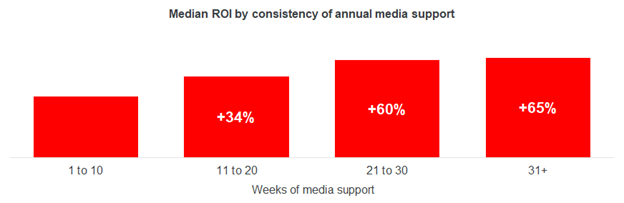
Burst campaigns are expensive because they keep restarting the job. Each time you go dark, you give up momentum and have to rebuild it. Continuity works differently. It reinforces what people already know rather than reintroducing yourself from scratch. Over time, that reinforcement compounds. You’re not just buying impressions but strengthening memory structures that make future advertising work harder for you.
The “frequency of 1” idea isn’t wrong, it’s just incomplete
Marketers love rules of thumb because rules feel safe. “Frequency of one” is one of those rules. As Paul Sinkinson, Managing Director Asia & Australia Analytic Partners explains, we never truly operated at a frequency of one on linear TV because we couldn’t cap it.
“The actual exposure levels were higher than the planning assumption and that’s part of why it worked.”
When we look at what “optimal” actually looks like in YouTube it’s not 1. Our modelling indicates 2.7 exposures per week is the ROI-maximising point for maintenance activity, and 3.8 exposures per week for launch activity.
Now here’s where it gets practical for a senior marketer: even those “optimal” points can be misleading if you apply them as a blunt instrument. Why? Because launches aren’t just about short-term ROI, they’re about building the structure that makes later efficiency possible. If you judge a launch like it’s a maintenance campaign, you’ll almost always under-invest early and then wonder why you can’t “optimise” your way to growth later.
Reach still matters but it has a sweet spot
The other thing digital video planning tends to do is underplay reach because it feels abstract compared to conversion metrics. But reach is the thing that stops you repeatedly preaching to the same choir.
In our norms, the highest ROI for reach still sits around 50–75% of the total audience - there’s a tipping point where it becomes less efficient, but the peak is still firmly in that middle band.
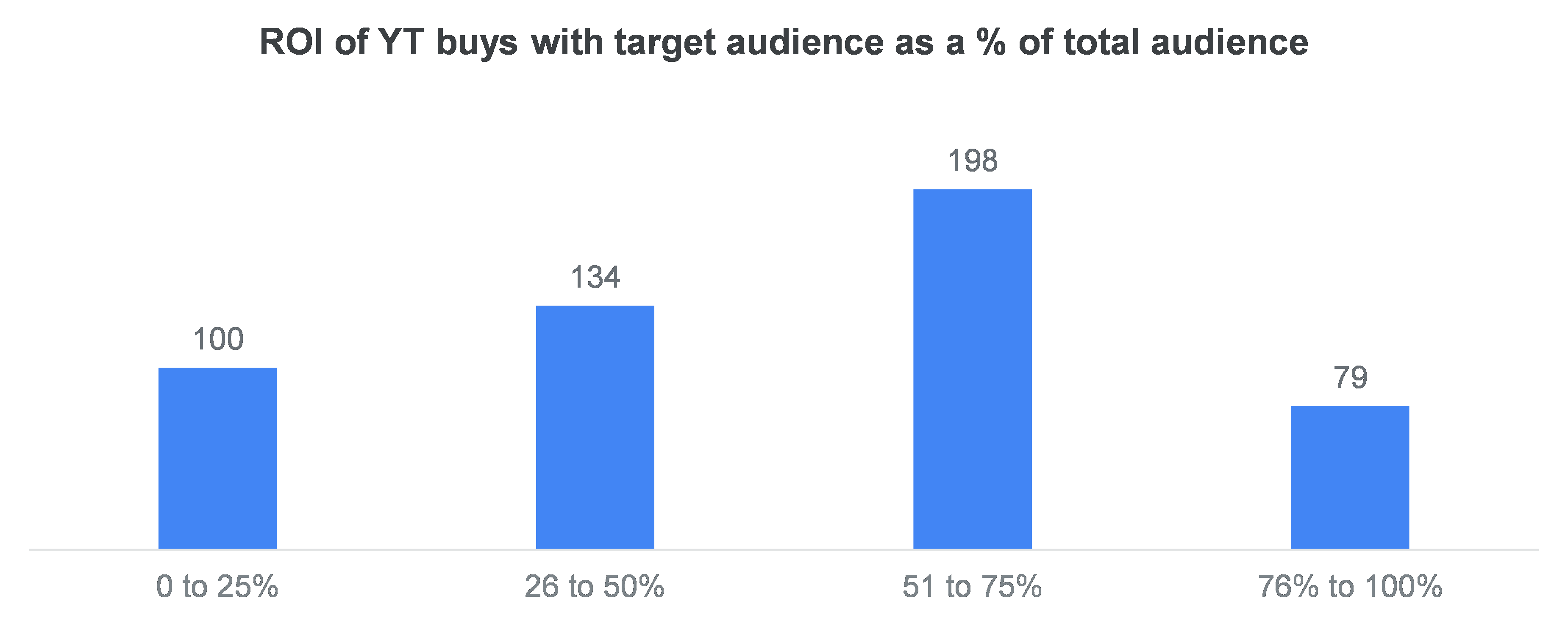
You don’t need to reach everyone. But you do need sufficient scale for memory to compound, particularly in a world where broadcast reach no longer happens by default.
Here’s the real punchline: “diminishing returns” is rare and often misread
Once you accept that you likely need more continuity, more reach, and more frequency than the old heuristics suggest, the immediate fear is: “Are we already spending too much?”
As noted earlier, only 1.3% of brands in Australia and New Zealand are genuinely at diminishing returns. That context matters here, because it reframes the anxiety - most advertisers aren’t pushing too far; they’re still operating below their potential ceiling.
But there’s a more important nuance hiding behind the headline. Digital video is often still the strongest ROI performer in the channel set, which means even when its ROI declines, it can remain the best contributor to total campaign ROI.
Paul highlights the commercial nuance clearly:
“We’ve seen scenarios where YouTube ROI could decline by 42% and still remain the strongest performer in the mix. It could halve and still outperform linear TV. So reacting to a softening curve without comparing alternatives can reduce total campaign ROI.”
This is the moment where many teams make the wrong call. They see a channel’s ROI falling and assume spend should be capped. But if the channel is still outperforming the alternatives, reducing it can lower overall ROI.
This is the move from channel-level optimisation to mix-level optimisation. And it’s where senior marketers earn their keep because it requires judgement, not dashboards.
Efficiency vs Effectiveness: The CTV Confusion
There’s a debate that keeps surfacing in video planning — and it usually goes something like this: YouTube is the efficiency play, BVOD is the effectiveness play. The logic sounds reasonable. BVOD delivers stronger impact per exposure, so surely it must be driving more growth? Not quite. And the math is worth understanding, because this distinction costs brands real money.

A stronger result per ad does not automatically mean a stronger overall outcome. If you are working with a fixed budget, the question is not which ad performs better in isolation. The question is: which option generates the most total sales for the money you have.
That is what ROI measures. ROI tells you how much additional return you get for every dollar spent. So the higher the ROI, the more total sales you generate from the same budget. This is where the confusion between efficiency and effectiveness breaks down. Higher efficiency does not mean lower volume. It means more output for the same cost.
So if YouTube delivers higher ROI than BVOD or other CTV options, allocating more budget to YouTube is not just an efficiency play. It is the decision that drives the most total growth.
The mistake is thinking you can improve ROI by spending less. Yes, the average may improve. But if you are measuring incremental impact properly, total sales fall as well. You have not improved performance. You have reduced it. ROI is not about making the numbers look better. It is about getting the most out of the budget you have.
This is what we see in practice. YouTube ads on CTV deliver higher response than any other device — and higher ROI than Linear TV (which sits at 39% of YouTube’s ROI) and higher than BVOD and SVOD (at 76%). Critically, YouTube is also scalable, so that higher return can be deployed across a larger share of budget.
Even where BVOD delivers strong impact per exposure, YouTube’s combination of higher ROI and scale makes it the stronger driver of total growth. So the next time someone frames this as efficiency versus effectiveness — push back. The real question is always: which option grows the business most, with the budget you actually have?
The bigger opportunity isn’t reallocation but unlocking more value inside the channel
If your ROI curve is bending, you don’t always need to substitute the channel. Often you need to change how you’re using it e.g. format, sequencing, creative fit, and goal alignment. Two examples from recent YouTube performance analysis illustrate the point:
Skippable is more efficient for maintenance campaigns, but for launch campaigns (new campaigns) non-skippable lifts 9% higher than skippable.
Vertical video is not just a “nice to test” anymore. Across the client base, Shorts is averaging +19% higher ROI and 55% higher response than any other vertical video and the fun (and slightly annoying) part? Creative is rarely optimised for Shorts right now, which suggests the performance ceiling may not be anywhere close to being reached.
What this means for CMOs
If you’re leading marketing across APAC or Australia right now, you’re balancing tighter budgets, fragmented screens and increased scrutiny. In that environment, simplistic rules feel safe: cap when ROI dips, flatten frequency, rotate budget but the more commercially accurate approach is this:
Treat diminishing returns as a portfolio question, not a panic signal.
Ask whether a channel still outperforms alternatives, even if its ROI has softened.
Optimise formats, sequencing and exposure levels before reallocating spend.
Recognise that continuity and scale are structural growth drivers, not “nice to have” extras.
Or, as Paul puts it:
“Do not automatically cap spend when a channel shows declining ROI. Instead, evaluate whether that channel still outperforms alternatives and contributes positively to overall campaign ROI.”
The real risk isn’t that you push too far into diminishing returns. The real risk is that you retreat too early and shrink the very engine that was driving growth, which is a far more expensive mistake.
Unsure whether you’re actually hitting diminishing returns or pulling back too early? Meet our modellers and see how Marketing Mix Modelling helps you optimise video investment across the full mix, not just one channel curve.