

We Asked 455 Marketers How They Make Investment Decisions. Here’s What They Told Us.
What’s shaping marketing investment decisions right now and where the gaps still sit.

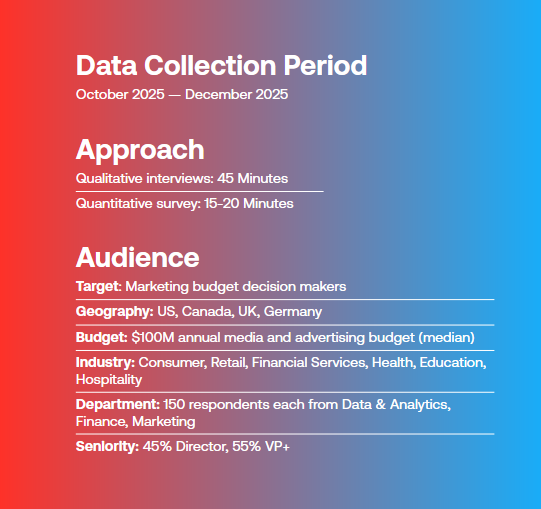
We recently spoke to 455 senior decision-makers responsible for marketing budgets, each with a median annual spend of $100 million.
This was not a quick poll. Each interview ran for 45 minutes, supported by a detailed survey exploring how investment decisions are actually made in 2026.
The answers were deeply revealing because, despite all the tools, dashboards and data available today, the way most organisations make budget decisions still isn’t as advanced as we might like to think.
We’ve broken this down into the five forces shaping how marketing investment decisions are really being made right now and what to do about them.
Insight #1: Data remains a limiter
For most large advertisers, data is still the biggest barrier to making confident decisions. Fragmentation, privacy constraints and difficulty integrating external data sources continue to slow teams down.
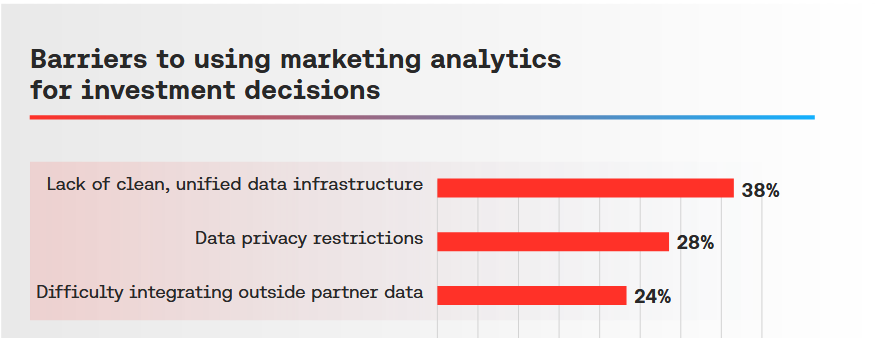
The issue, it seems, is no longer access to data. It is the ability to connect, interpret and apply it in a way that drives action. The practical implication for CMOs is clear, they don’t need more data, rather, usable, connected, decision-ready data.
Our take? Organisations that adopt privacy-safe, model-based methods can overcome many obstacles that have stalled progress. Approaches that integrate data across time and geography, rather than people and devices, are inherently more resilient to fragmentation and privacy constraints. Together, these methods create a more stable, durable, and holistic foundation for confident decisioning.
Insight #2: External factors are the critical gap
It is not just about marketing performance data, the bigger issue is what sits outside of it. External factors such as pricing, distribution, competitive activity and macroeconomic conditions are still poorly integrated into decision-making. That matters because marketing does not operate in isolation (and it never has), yet most measurement systems still treat it as if it does.
Broader ROI Genome analysis shows that marketing typically drives only 10% to 50% of business outcomes directly, with the rest influenced by factors beyond marketing. If your measurement system only captures marketing activity, you are only seeing, and optimising, part of the picture.
Analytics gain a great deal more credibility when they reflect the environment in which decisions are made. Models that incorporate external context allow leaders to explore what-if scenarios with shifts to that context and forecast new expected outcomes
Insight #3: Marketing budget decisions are the least data-driven
First the good news: very few leaders rely purely on gut these days - only about 3%. Most blend data with experience, and the remainder depend on the data (shown below). However, marketing leaders are far less likely to take a highly data-driven approach (22%) compared to their Finance (45%) and Analytics (36%) counterparts. This gap shows that even with widespread analytic tools, many teams still default to judgment over data when setting budgets.
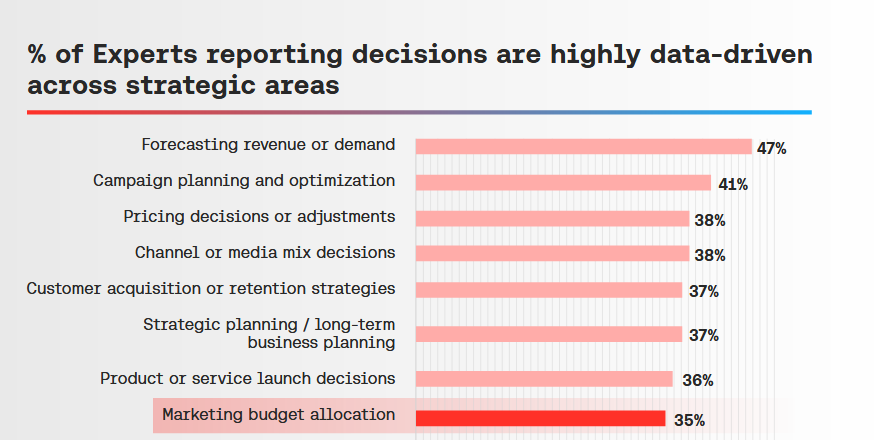
There is plenty of evidence that organisations whose decisions are rooted in robust measurement consistently outperform their industry peers so why is marketing lagging? We believe marketing leaders have the greatest opportunity to raise their own decisions rigour by lifting budget allocation from the least data-driven strategic area to one that performs at least on par with other departments.
Insight 4: Marketing Mix Modeling is the most-cited source of truth
I’ll hand over to one of our participants to illustrate this point:
“In a data-fragmented environment, Marketing Mix Modeling is one of the few measurement frameworks that can penetrate the data black box and provide a comprehensive operational perspective. It can not only quantify the marginal contribution of different channels, but also reflect the impact of external market factors on the overall market, which is something that single-point attribution cannot achieve.”
Business Intelligence Director, Media & Gaming
Couldn’t have said it better myself!
Insight 5: Marketing Mix Modeling must match the speed and volatility of your business.
Among organisations using MMM, or it’s big brother Commercial Analytics, 82% receive new or updated results at least quarterly. This aligns with the reality that major advertisers revisit budgets and reallocate spend multiple times per year as conditions change.
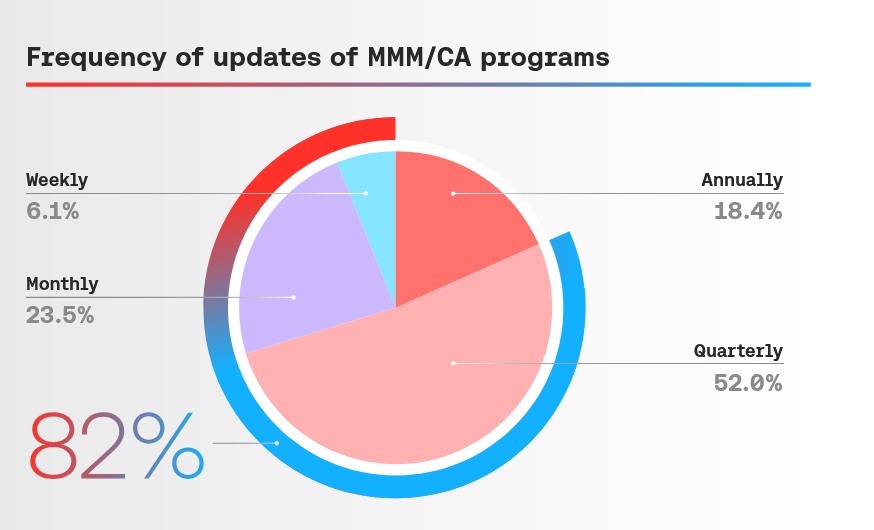
When measurement lags behind the business, it stops being a decision tool and becomes a historical record. MMM is a powerful test-and-learn engine that enables opportunities identified in one quarter to be implemented in the next and measured for impact. That repeatable reinforcement cycle builds executive confidence in the outputs and, over time, accelerates the shift from “balanced” decisions to the data-first decisions that drive predictable growth.
What does this mean for CMOs?
Taken together, these findings point to a shift in how marketing needs to operate, using reporting as a live decisioning tool rather than an historical artifact. And it’s not about who has the most data but who can:
Integrate marketing with the wider business system
Make confident decisions despite imperfect data
Balance short-term performance with long-term growth
Move at speed without losing rigour
Align Marketing, Finance and Analytics around a shared view of how growth is created.
Because that alignment is what will turn insights into action. Want to know more? This article only scratches the surface of what 455 senior marketers, finance leaders and analysts shared with us. If you want to understand how leading organisations are evolving their approach to marketing investment and what it means for your own decision-making, the full report is well worth your time.
👉 Download the full report: Five Forces Shaping Marketing Budget Decisions in 2026