


Welcome to the first award winning edition of The CMO Office!
Last night we were proud to take home Silver for Best B2B Content Marketing Strategy for ‘The CMO Office’ at Marketing Interactive’s Content 360 Awards, in no small part thanks to your support so thank you and please keep on subscribing, reading and sharing, Nx🙏

Now, where was I?
Oh yes, when I spoke at the Digital Marketing Summit in Seoul recently, I wanted to focus on a gap that most marketers recognise but rarely address directly; the world moves quickly but our plans do not…
Many organisations are still working to annual plans set months ago, sometimes close to a year in advance. Those plans were built on a set of assumptions about demand, pricing, supply, competition and consumer behaviour that may no longer hold true.
At the same time, the dashboards used to track performance tend to capture only part of the picture. Campaign metrics update constantly, but they rarely reflect the broader forces shaping results. For instance, a campaign may underperform not because the media plan is wrong, but because distribution has shifted. Or results may appear strong when demand has been artificially inflated by external factors.
The consequence is a growing disconnect between what marketers see and what is actually happening in our complex world. So, what can we do?
1. Don’t blindly believe your dashboard
Modern marketing dashboards are powerful. They provide real-time visibility into campaign performance across channels but they are not designed to capture everything that drives results. They are only the tip of the iceberg.
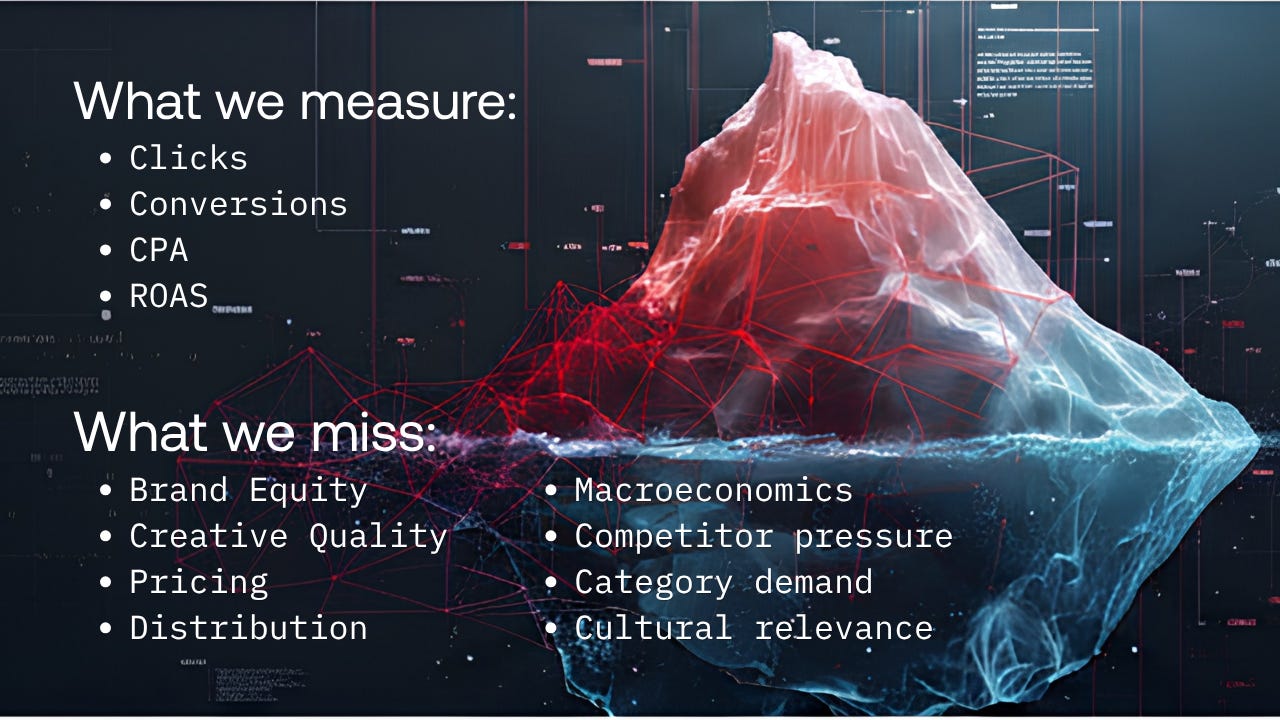
Most dashboards focus on media metrics: impressions, clicks, conversions, ROI. These are important, but they sit within a much wider system. Marketing outcomes are shaped by a combination of factors such as pricing decisions, distribution availability, competitive activity, macroeconomic conditions and consumer sentiment, which all play a role.
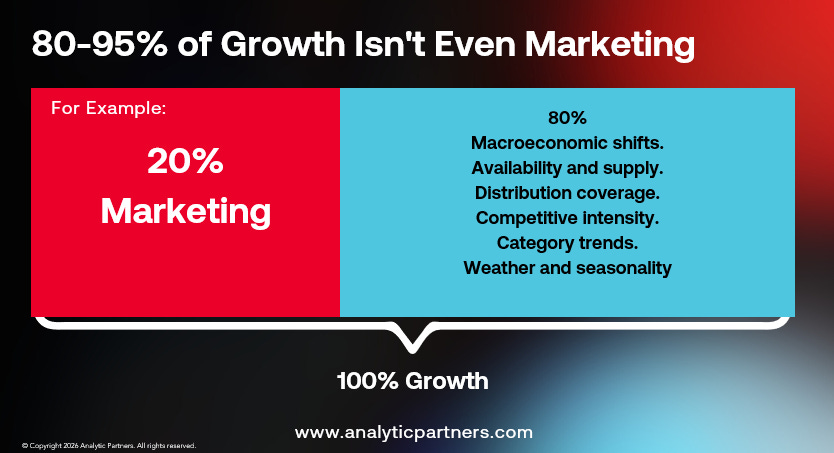
Our proprietary ROI Genome analysis shows that marketing contributes between 10 percent and 50 percent of business performance, with the majority influenced by factors beyond marketing itself. When these elements are not included in measurement, performance can be misinterpreted. A campaign may appear underwhelming when the real issue is product availability. Strong results may be attributed to media when they are driven by external demand shifts.
Without a broader view, decisions are made on incomplete - even misleading - information.
2. Widen your field of vision
Speaking of taking a broader view, one of the key points I shared in Seoul is that marketers need to widen their field of vision.
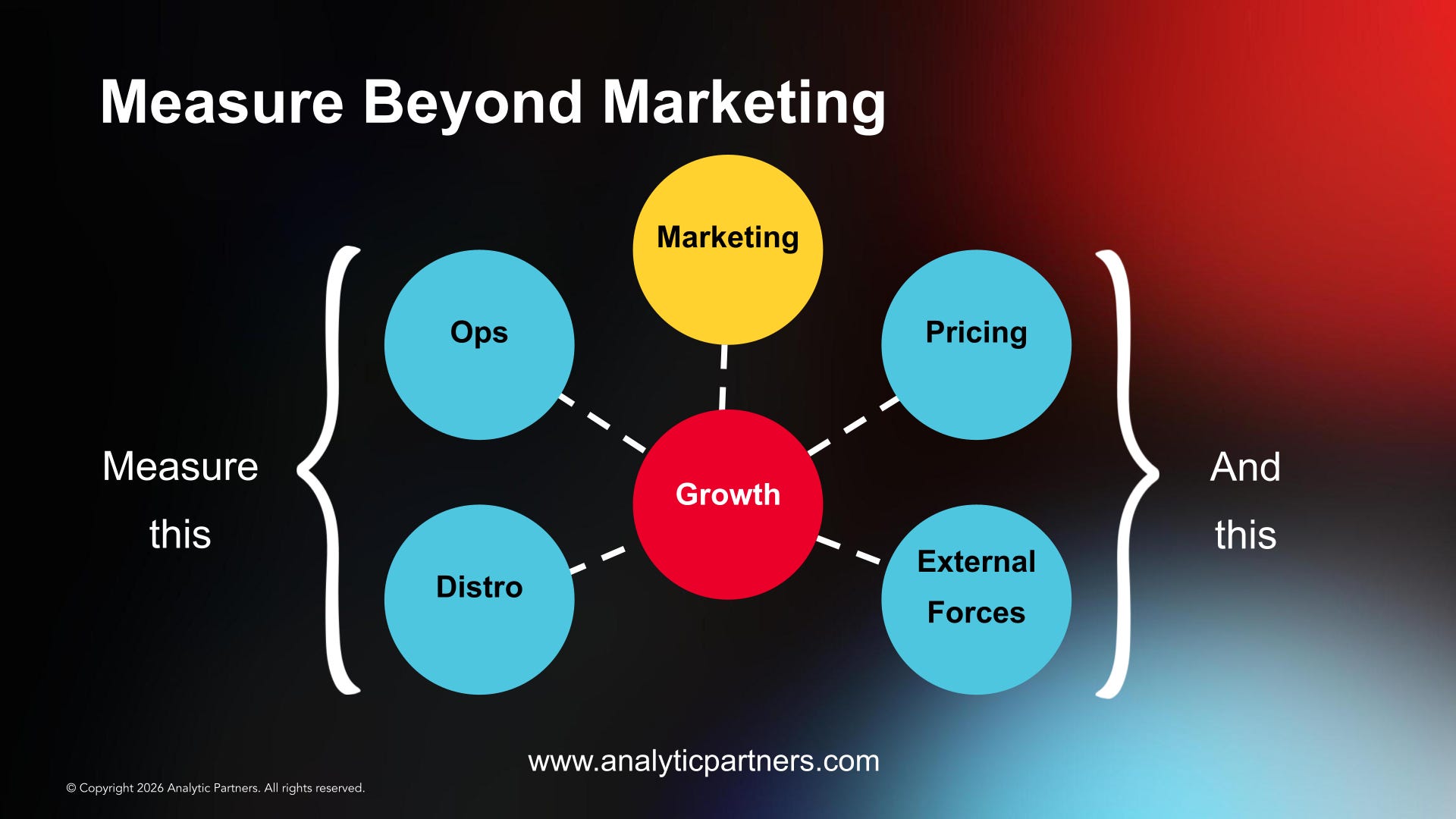
Understanding performance requires looking beyond individual channels and beyond marketing itself. It requires a view of the full commercial system. This includes how channels interact with each other. It includes how brand and performance activity work together. It includes how external factors influence demand.
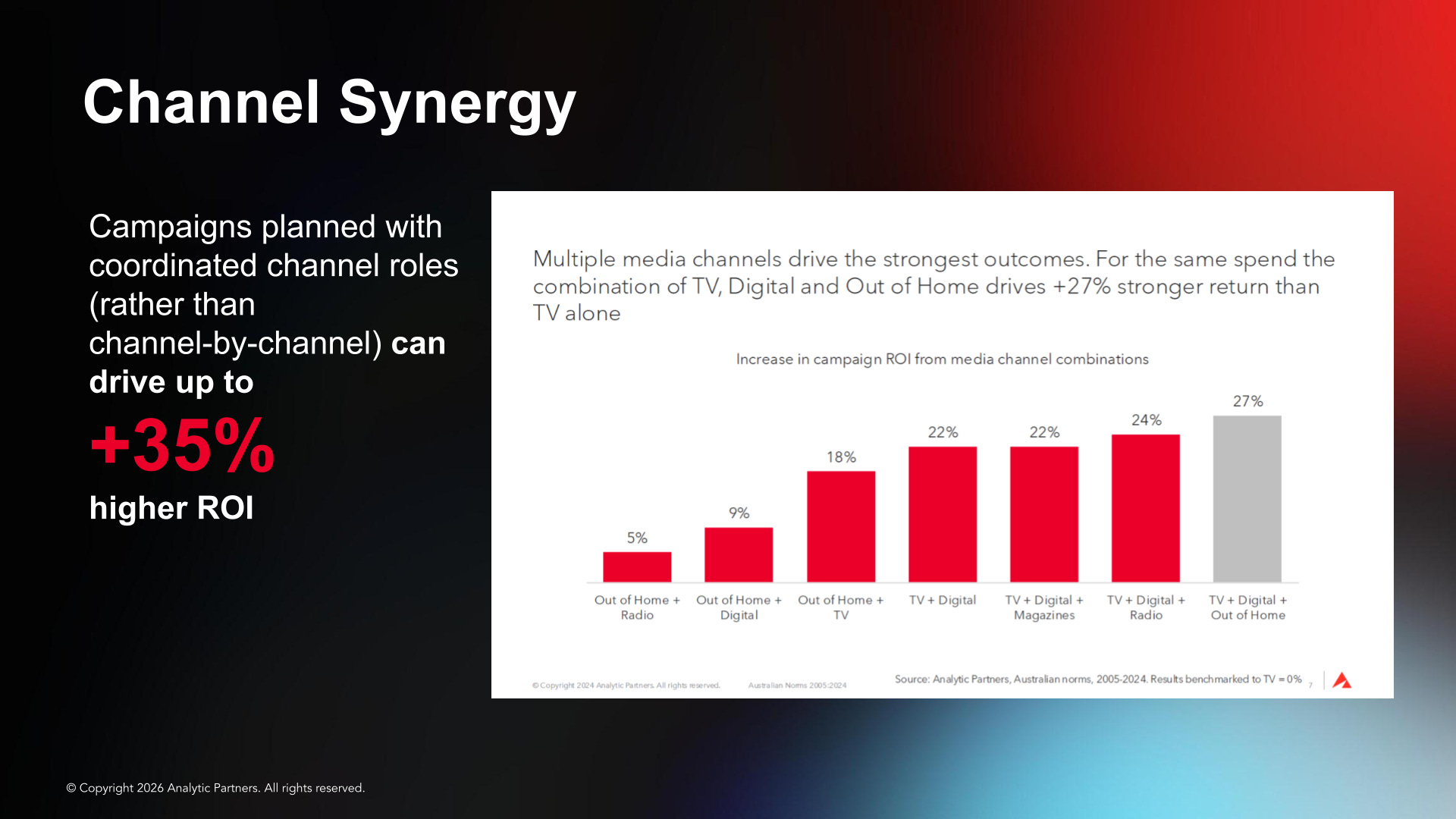
Integrated strategies consistently outperform siloed approaches. Combining online and offline channels delivers significantly stronger results, with up to 50 percent greater efficiency compared to single-channel strategies .
These effects are not visible when channels are measured in isolation. They only emerge when the full system is considered.
3. You can’t predict the future. But you can prepare for it.
Now you can see more of the picture, the question becomes: what do you do with it?
Most organisations are still set up to look backwards. Campaigns are analysed after they finish. Insights arrive once the moment to act has passed. In a stable environment, that delay is manageable. In a volatile one, it becomes a risk.
Because the reality is, you cannot forecast the future with certainty. But you can prepare for it. Reporting tells you what happened and simulation tells you what could happen.
That means building scenarios in advance. Understanding how your business responds to different conditions. Knowing which levers to pull, what to pull back on, how to adjust pricing, and how to rebalance your mix across brand and performance when conditions change.
Because when those moments come, and they will, the organisations that win are not the ones scrambling for answers. They are the ones who have already pressure-tested the decisions. This is where marketing moves from reporting the past to shaping what happens next.
4. Use Marketing Mix Modelling
And this is precisely the context in which marketing mix modelling becomes most valuable.
At its core, marketing mix modelling provides a structured way to understand how different factors contribute to performance. At Analytic Partners, we extend this into Commercial Mix Modelling, which goes beyond marketing to include pricing, distribution, operational factors and macroeconomic conditions. It connects marketing activity with broader business drivers and external conditions, which makes it uniquely suited to today’s environment.
Rather than relying on partial metrics, Commercial Mix Modelling provides a holistic view of performance, enables forward-looking scenario planning and supports continuous recalibration.
It is no longer just a retrospective tool used to validate past decisions. It is becoming a system for ongoing decision-making, not by measuring in real time, but by pre-planning scenarios so teams know how to respond when conditions change.
Companies that adopt this kind of approach move faster and make more confident decisions. Organisations that embed data-driven decisioning into their operating model have been shown to achieve significantly stronger growth outcomes, including up to five times the growth of those that do not.
5. Move from plans to possibilities
The implications for marketers are clear:
Annual plans still have a role, but they cannot remain static. They need to evolve as conditions change.
Measurement needs to extend beyond campaign metrics to include the full set of factors influencing performance.
Decision-making needs to shift from retrospective reporting to continuous, real-time optimisation.
Most importantly, marketers need to recognise that the environment they operate in is not fixed. It is dynamic, interconnected and often unpredictable.
The path forward
The gap between the pace of the market and the pace of marketing decision-making is becoming more visible. Closing that gap requires more than better dashboards. It requires a different approach to measurement. One that captures the full system. One that looks forward as well as back. One that enables faster, more informed decisions because in a world that does not stand still, marketing cannot afford to either.
If you would like to hear the full keynote, you can listen to my session from the Digital Marketing Summit on The CMO Office Podcast, available now on Spotify, Apple Podcasts and YouTube.


